
5 Lessons for Deeptech Companies from a Unicorn founder Nigel Toon


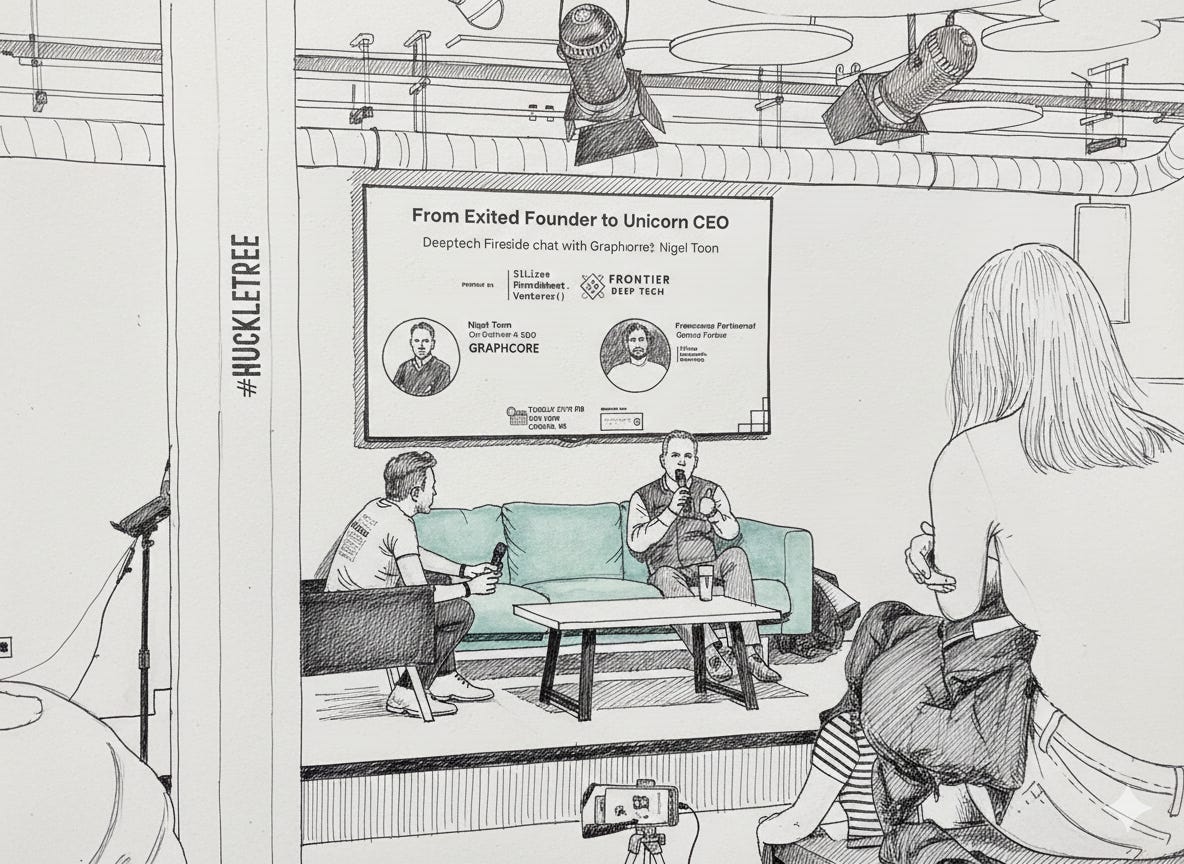
Nigel Toon is an engineer who became one of the most successful chip entrepreneurs in the world. After top roles at Altera, he co-founded Icera (sold to NVIDIA for $435M) and led companies like Picochip and XMOS. In 2016, he started Graphcore, a unicorn startup valued at $2.8B that builds specialized chips to compete with NVIDIA. He now advises the UK Prime Minister on business and recently wrote the book How AI Thinks.
After the fireside chat with Nigel we extracted 5 lessons of building a deeptech giant from the ground up. In this newsletter you can find:
How to split the resources between R&D and winning the customer
Who to look for in corporates for efficient collaboration
The ideal size of teams for scaling
Why the goal of each CEO should be doing nothing
1. The 50/50 Rule
Technical founders often confuse a scientific breakthrough with a business. Spending 90% of your capital and mental bandwidth perfecting the Tech is a recipe for failure - and what often differentiates European and American deeptech companies. The US vs. EU Gap: American companies focus on product management, engaging with customers and refining the product roadmap equally as much as on the technology.
The truth is, if you’re spending majority of your resources solely on R&D, you aren’t building a company, you’re running a laboratory.
The Golden Ratio: At least 50% of your total investment - time, capital, and mental bandwidth must go into winning customers. - Nigel Toon
2. Be able to solve a problem with only your technology
Scale doesn’t come from being everything to everyone, it comes from being everything to the few key customers. The Strategy: Find a problem so specific that only your proprietary tech can solve it.
Find the key customers.
Obsess over them.
Dominate that corner.
Then earn the permission to win the whole market.
3. The Multiplier of 8 Rule for Teams
Scaling isn’t just adding heads, it’s about maintaining velocity. Nigel shares his experience with optimal organisational design also called The Multiplier of Eight.
The Unit (8 people): A single, cohesive cell.
The Growth Peak (64 people): The perfect size for a high-growth startup.
At 64 (8x8), you can still know every face, name, and function - everybody understands the values, mission and their place in the company. The moment you cross this threshold, the “magic” often breaks. You suddenly require layers of management and formal processes. The trick is to stay deliberately small for as long as possible. Lean mass is what allows you to move fast enough to get big.
4. Meet the “Problem Owners,” Not the “Innovation Department”
Your time is best spent in the trenches with your customers. However, you must be selective. Prioritize meetings with the people who actually own the problem and the budget to fix it and don't waste years in pilots that go nowhere.
Avoid: “Innovation Departments” whose job is to look at new tech but rarely have the power to buy it.
Seek: The engineers and managers whose daily lives are made miserable by the current limitations of the market. They are your true champions.
“Focus on who the actual decision makers are in the corporation and who the real people with real projects are” - Nigel Toon
5. The CEO’s Paradox: The Goal is Obsolescence
It sounds counter-intuitive, but the ultimate goal of the CEO is to do nothing. True scale is achieved when you build a system so robust and a team so aligned that the company no longer requires your input on daily decisions. If the gears stop turning the moment you leave the room, you haven’t built a company; you’ve built a high-stress job.
The reality ? Don’t worry that is never going to happen anyway and there will be enough fires to put out, rounds to raise and issues to solve.
The Bottom Line
Building a deeptech giant requires a rare blend of visionary arrogance (to believe you can beat the NVIDIAs of the world) and operational humility (understanding that executing that is exceptionally difficult and requires a lot). You can find the whole interview here.
Really liked this, especially the emphasis on not confusing a lab with a company.
One nuance from the hard deeptech side is that sometimes you genuinely can’t get to a trivial MVP. The very thing that makes the company non-obvious is often buried deep in the stack. If you abstract it away too early, you lose the point.
You still need something customers can touch. In practice that often means building a thin, usable surface around a very unfinished core. It means being explicit with early design partners that they’re seeing “inside the factory,” not a polished product. And it often means using simulations, constrained environments, or narrow workflows as proxies until the deeper technology is stable enough.
That’s also where the engineering vs customer split gets subtle. A 50/50 balance sounds right in theory, but in early hard deeptech the split is really about risk. Engineering reduces technical risk. Customer development reduces market risk. The weighting depends on what would actually kill the company at that stage.
If you raise a small pre-seed, you’re not funding parallel machines. You’re funding proof of inevitability. That usually means depth has to move slightly ahead, but always in service of unlocking real customer conversations.
At Qognetix we’re leaning into regulated markets, where engineering is done for the customer and science is done for validation. In that context, depth isn’t optional. But it has to be tightly coupled to auditability and real-world constraints.
The art, at least for us, is keeping that depth narrowly scoped and obsessively tied to a few painful, ownable problems, rather than trying to MVP the entire stack at once.