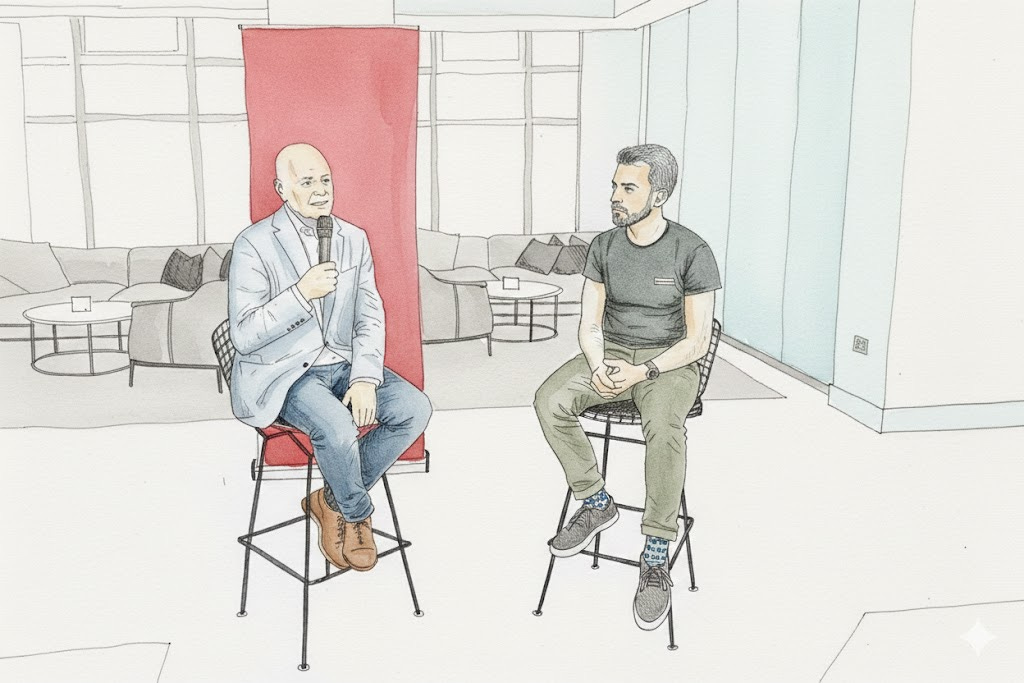
Martin Frost on building a $4B European Robotics Company
Lessons on how to build a European Robotics Deep Tech Unicorn


We recently sat down with Martin Frost, the force behind one of the UK’s biggest successes in the deeptech space CMR Surgical - a hardware robotics company last valued at $4 Billion!
Below are the 9 most striking lessons learned from our conversation: from raising nine figures on a boat to the “invisible tax” of scaling a global giant.
1. Solve a Problem for, don’t sell a Product to the customer
Every great founding story begins with a “Why.” For the CMR founders, the pivot point came during a 2012 meeting in a pub. They realised the market was saturated with “Ferraris”, surgical robots that were technically impressive but prohibitively expensive and physically massive.
Existing robots didn’t do the range of surgical procedures that surgeons were actually demanding. The team didn’t set out to build the most complex machine, they set out to build the one that fit the practical, real-world workflow of the operating room.
The Lesson: True market disruption happens when you prioritise the surgeon’s actual needs, budget limitations and practicality over technical vanity.
2. The Power of Radical Skill Diversity
Traditional venture logic suggests that two founders are the “sweet spot.” CMR team ignored this, launching with five. In a field as complex as medical robotics, “one genius” is a bottleneck. The team needed mastery in embedded hardware, mechanical engineering, software, and data science simultaneously.
“None of us were the same, we were all frankly completely different in terms of personality and skills.” - Frost says
The Lesson: With hardware, many times, your greatest strength isn’t fast alignment, it’s the ability to “argue in a friendly way” to find the optimal engineering truth.
3. The Wooden Prototype Milestone
In the early days, before they had millions in the bank, the team built their vision out of wood. Today, that wooden prototype sits in the British Museum.
It couldn’t perform surgery, but it performed the ultimate task: generating conviction. It allowed surgeons to touch the joints and feel the ergonomics long before a single piece of medical-grade steel was cut.
The Lesson: Physicality is the antidote to skepticism. If an investor can touch it, they can believe it.
4. Navigating the “Capital Gap”
Frost is candid about a staggering reality: of the £300 million eventually raised, only about £20 million came from the UK. “I talked to dozens and dozens of VCs in the UK... I couldn’t raise the money.” His first major check came from Scandinavia, followed by capital from Singapore, Hong Kong, and the U.S.
The Lesson: If your local ecosystem lacks the “scale of capital” for your ambition, don’t waste time trying to change their DNA. Change your flight destination.
5. Conviction at Sea: Raising £100 Million on a Yacht
Fundraising is often romanticised as a boardroom activity, but Frost’s favourite story involves a RIB boat and a suit. While speaking at a conference in the South of France, Frost received a call from an existing investor asking when he was headed home. When he replied he was on the airport, the investor replied: “I’ll send a car to pick you up.” Still in his suit on a beach where he walked over the sand to a waiting boat. Three miles offshore, over ten hours on an investor’s yacht, he raised £100 million.
The Lesson: Be prepared to pitch anywhere. Capital follows conviction, regardless of whether you’ve had a change of clothes in the last 24 hours.
6. Leadership via the Joke Shop
Frost was known for visiting a local joke shop before company updates, once addressing his team dressed as a Christmas turkey another time as a Star. This wasn’t mere eccentricity, it was a strategic dismantling of hierarchy. By never having an office and making himself a “bit ridiculous,” he ensured the culture stayed open and energised.
The Lesson: Psychological safety within the organisation makes radical difference. When the CEO isn’t “precious,” the team feels safe to innovate.
7. The Trap of “Version 2”
In the race to the top, both investors and entrepreneurs suffer from “next-gen obsession.” Frost admits that while their first product was excellent, they were already fixated on the next iteration. “The right thing to do should have been a limited release of Version 1 before we went to a better Version 2.”
The Lesson: Clinical data from a “Version 1” in the real world is worth more than a thousand lab simulations of a “perfect” Version 2.
8. Seeking the Boardroom Sanctuary
“It’s a lonely journey as a CEO,” Frost reflects. He worked through four chairpersons, searching for one with whom he could share his core challenges with without fearing for his position. He now prioritises this “bridge” role for the companies he chairs, encouraging founders to lead with their worries rather than their slides.
The Lesson: Your Chair should be a bridge to your investors, not a judge.
9. The “Success Penalty” and Mental Absence
Frost speaks openly about his wife’s support through years of intense pressure. His regret wasn’t the hours spent working, but the “mental absence” being physically present at home while his mind was 3,000 miles away solving a robotics glitch.
The Lesson: Protect the support system that allows you to go the distance. When Frost eventually stepped down, his wife’s sadness lasted “about 20 seconds” before they headed to North Norfolk for birdwatching.
The CMR Blueprint: The Engine of Growth
Beyond the high-level strategy, CMR Surgical succeeded because of these moves as described by Martin:
Insane Speed: They moved from a standing start to clinical use in a hospital in just five years a pace almost unheard of for such complex hardware.
Ownership Culture: Key strategy to increasing ownership was distributing options widely across the entire company
Commercial Borderlessness: Recognising the UK market was too small for their ambitions, the leadership and team was global from the beginning.